protoc-gen-pydantic
Define your data schema once in Protobuf. Get validated, type-safe Python models automatically.
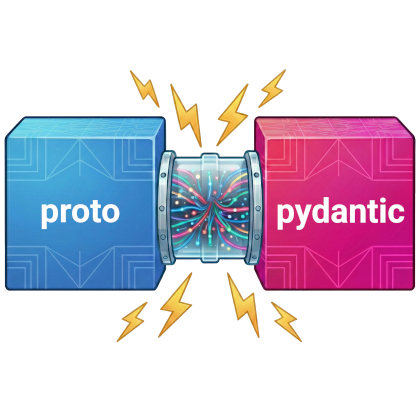
If you work with Protobuf APIs in Python, you face a familiar tradeoff: use the raw _pb2
classes — no validation, no editor support — or hand-write parallel Pydantic models and keep
them in sync forever. protoc-gen-pydantic generates Pydantic v2 models directly from your
.proto files, so your schema stays the single source of truth.
How it works
protoc-gen-pydantic is a protoc plugin written in Go. You run buf generate (or protoc)
once, and the plugin reads your .proto files and writes ready-to-use Python files alongside
them. After that, code generation is the only step — no runtime dependency on the plugin itself.
flowchart LR
    A["proto/user.proto"] -->|buf generate| B["gen/user_pydantic.py<br/>gen/_proto_types.py"]
    B --> C["from user_pydantic import User"]
Every generated message class inherits from _ProtoModel, a thin base class that overrides
model_dump and model_dump_json with ProtoJSON defaults on top of standard Pydantic. See
Generated Model API for the full interface.
Basic usage
A single buf generate command turns any .proto file into a ready-to-use Pydantic model:
The generated model validates inputs immediately — no extra setup, no runtime surprises.
With validation constraints
Add buf.validate constraints to your proto fields, and the generator translates them
directly into Pydantic validation:
syntax = "proto3";

package example;

import "buf/validate/validate.proto";

// A user account.
message ValidatedUser {
  // Display name (1–50 characters).
  string name = 1 [
    (buf.validate.field).string.min_len = 1,
    (buf.validate.field).string.max_len = 50
  ];

  // Age in years.
  int32 age = 2 [(buf.validate.field).int32.gte = 0];

  // Contact email address.
  string email = 3 [(buf.validate.field).string.email = true];

  enum Role {
    ROLE_UNSPECIFIED = 0;
    ROLE_VIEWER = 1;
    ROLE_EDITOR = 2;
    ROLE_ADMIN = 3;
  }

  Role role = 4;
}
class ValidatedUser(_ProtoModel):
    """
    A user account.
    """

    class Role(_ProtoEnum):
        UNSPECIFIED = ("UNSPECIFIED", 0)
        VIEWER = ("VIEWER", 1)
        EDITOR = ("EDITOR", 2)
        ADMIN = ("ADMIN", 3)

    # Display name (1–50 characters).
    name: str = _Field(
        description="Display name (1–50 characters).",
        min_length=1,
        max_length=50,
    )
    # Age in years.
    age: int = _Field(
        default=0,
        description="Age in years.",
        ge=0,
    )
    # Contact email address.
    email: _Annotated[str, _AfterValidator(_validate_email)] = _Field(
        description="Contact email address.",
    )
    role: "ValidatedUser.Role | None" = _Field(
        default=None,
        examples=[1],
    )
The generated model is immediately usable — construct, serialize, and validate with standard Pydantic:
from user_pydantic import ValidatedUser

# Construct and validate
user = ValidatedUser(name="Alice", age=30, email="alice@example.com", role=ValidatedUser.Role.EDITOR)

# Serialize (ProtoJSON — omits zero values, uses camelCase field names)
print(user.model_dump_json())
# {"name":"Alice","age":30,"email":"alice@example.com","role":"EDITOR"}

# Validation errors are raised immediately
ValidatedUser(name="", age=-1)  # raises ValidationError (3 validation errors)
Acknowledgements
This project is a fork of ornew/protoc-gen-pydantic by Arata Furukawa, which provided the initial plugin structure and plugin options. This fork adds well-known type mappings, Python builtin/keyword alias handling, cross-package references, enum value options, ProtoJSON-compatible output, buf.validate constraint translation, CEL expression transpilation, conditional imports, and a full test suite.